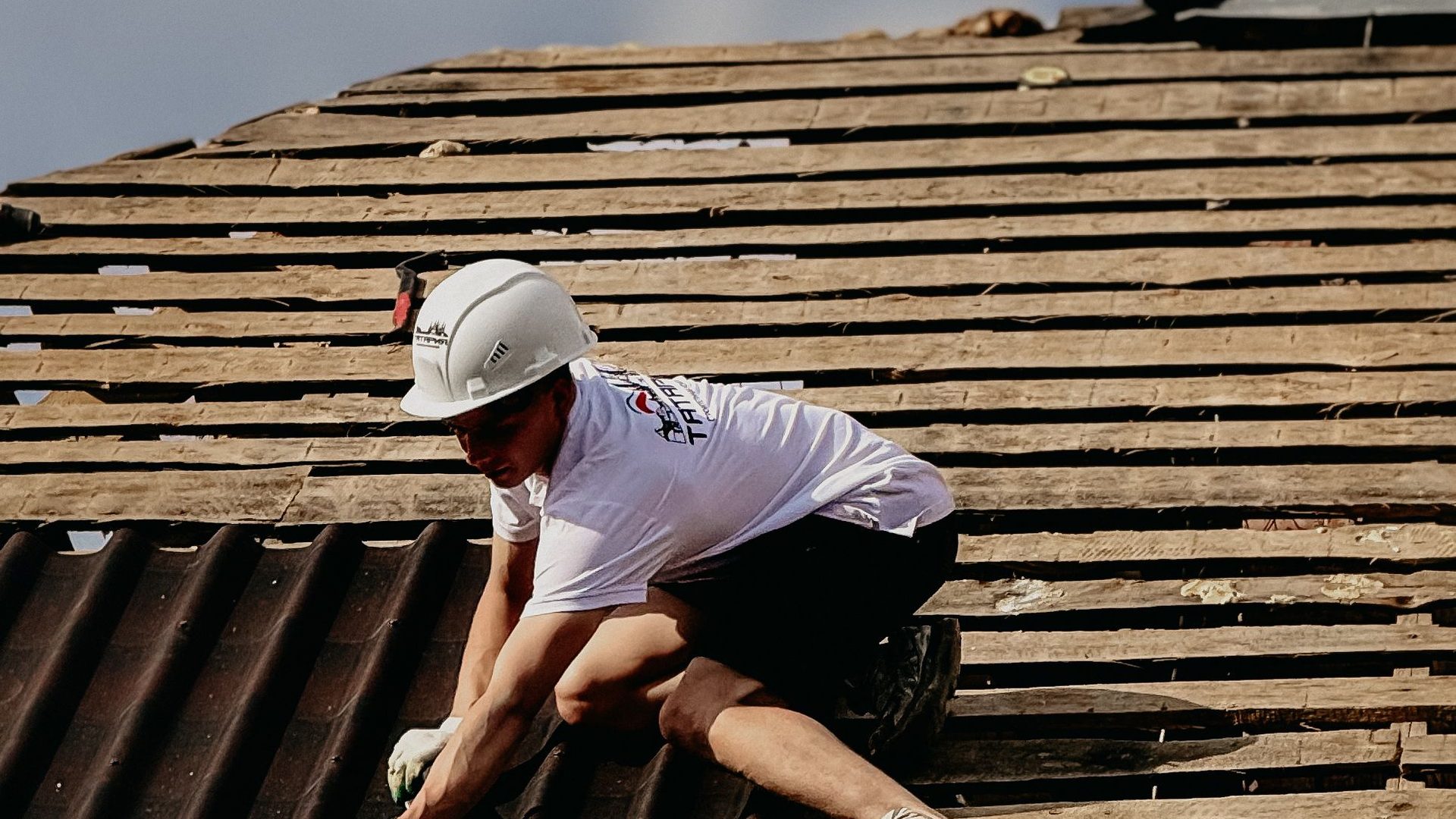
A roof on the Nevada shore of Lake Tahoe has almost nothing in common with a roof in the Las Vegas valley. It carries weight for months, sheds what it cannot carry, and has to keep the building warm without warming itself. Almost nothing that decides a valley roof decides one here.
What is actually on roofs at the lake
Lodging and resort property, restaurants, retail, offices, marina and service buildings, and a large amount of association and multifamily property. Much of it is timber framed, with steep pitches, dormers, deep overhangs and valleys. Low slope sections sit among all of that, over corridors, entries, kitchens and mechanical rooms, usually tucked below a taller roof that sheds onto them.
Coverings are chosen for weight and for shedding rather than for what they reflect. Metal is common because it sheds, and where a roof sheds, snow retention has to be fastened through to the structure rather than to the panel alone. A slab of snow released over an entry, a walkway or a lower roof is a safety problem and a repair bill. On the low slope areas the membrane has to survive standing snow, meltwater and somebody with a shovel, which argues for thickness, for attachment specified against the load, and for walkways.
Two things matter more here than the covering itself. The underlayment, because at the eaves and in the valleys it is what keeps water out once ice has formed above it. And the assembly below the deck, because a roof that loses heat into its own snow cover is manufacturing the thing that breaks it.
Snow load, ice and the details that take it
Load first, and not as an average. Snow does not sit evenly. It drifts against anything that stands up: parapets, screens, curbs, and the wall where a tall roof meets a low one. It also arrives all at once when the roof above sheds onto the roof below. So we look hardest where those loads concentrate, not at the open field.
Ice damming is the failure everyone recognizes and most people misdiagnose. Heat leaves the building, snow melts on the field, the water runs down to a cold overhang and freezes there, and the dam that builds holds water against laps that were never meant to be submerged.
Stopping it is a ventilation and air sealing question as much as a roofing one. Either the assembly is vented, with intake at the eave, a clear path above the insulation and exhaust at the ridge, or it is unvented, with continuous insulation above the deck and an airtight ceiling below. Half of each is worse than either, because warm moist inside air reaches a cold surface, condenses, wets the insulation and rots sheathing quietly while it feeds the ice outside.
Then freeze and thaw, which is the slow one. Water works into a seam, a coping joint, a fastener hole or a crack, expands as it freezes and opens the gap slightly. Nothing fails on the first cycle. Everything fails eventually, which is why details here are built for repetition: fewer joints that depend on a bead of sealant, and metal laps arranged to shed on their own.
A season that closes
Work is planned backwards from a window that shuts. Nothing is opened that cannot be closed and made watertight before the crew leaves, which on a replacement means small daily sections rather than a wide tear off, and a program with the inspections already booked into it.
Staging needs thought a valley lot does not. Where does material stand when the lot is holding plowed snow, and where does the debris container go. Lodging property is busy in both seasons, so the quiet weeks and the workable weeks are the same and they fill early. Tell us the property calendar and we will build the program around it.
Common questions
Why does our Lake Tahoe building leak at the eaves rather than out in the field?
Because the eave is the coldest part of the roof and the field is the warmest. Heat escaping through the roof melts the underside of the snow, and that meltwater freezes when it reaches the unheated overhang.
- The ice builds into a dam and water stands behind it
- Standing water finds the laps of a covering designed only to shed
- The leak shows at the wall head, so the covering gets blamed and replaced
- A continuous self adhered membrane at eaves and valleys, with sealed laps
- Then stopping the heat that made the meltwater in the first place
So we look inside as well as on top: insulation blocking the eave vents, recessed fittings and hatches leaking warm air, fans discharging into the roof space, and duct runs losing heat where nobody sees them. Heat cable in a gutter manages the symptom and replaces neither half.
Should snow be cleared off a commercial roof at the lake, and who should do it?
Sometimes it has to be, and most of the roof damage we see from snow is caused by the clearing rather than by the snow.
- A metal shovel finds a membrane, a seam or a flashing
- Chipping ice along an eave takes the edge metal and underlayment with it
- A roof rake dragged up a panel roof catches clips and trim
- Snow thrown onto a lower roof moves the load where it is least wanted
- Plastic tools only, a layer left in place, ice left alone
Walk the roof in autumn with whoever will be up there and mark what they cannot see under snow: drains, skylights, curbs, low parapets and the edge itself. The safety question is the serious one, and it is a decision for somebody equipped for it rather than whoever is available.
Can we use the same roof system here as on our building in the valley?
The same manufacturers, often. The same specification, no. Reflectivity and daily thermal movement decide a valley roof. Here the roof carries weight for months and stays watertight while water above it turns to ice and back.
- Attachment specified against load and the drag of sliding snow
- Membrane thickness enough to survive being walked on, shoveled and loaded
- Flashings and curbs carried above snow that stands and drifts
- Penetrations grouped, with crickets uphill so meltwater splits around them
- Drainage and overflow planned for meltwater that runs only when it is warm
Insulation continuity is a waterproofing decision here, not just an energy one, because every gap that leaks heat is manufacturing the ice that gets under the covering.
Which building department covers the Nevada shore, and does the regional agency get involved?
Not Clark County, which is the first thing to say. The Nevada shore sits in Washoe and Douglas counties, whose requirements are written for snow country, and the Tahoe Regional Planning Agency also has a say in work around the lake.
- A scope that passes without comment in the valley is not automatically acceptable
- Establish which county the address falls in before the specification is finalized
- Ask early what applies to your scope, especially where the outside changes
- A new profile, a different covering or color, added equipment, a screen
- A like for like replacement and a change in appearance are different applications
Do it early because approvals run on their own clock and the working season does not wait. Ask your contractor which of these offices they have actually submitted to, and get the inspection sequence into the program at the start.