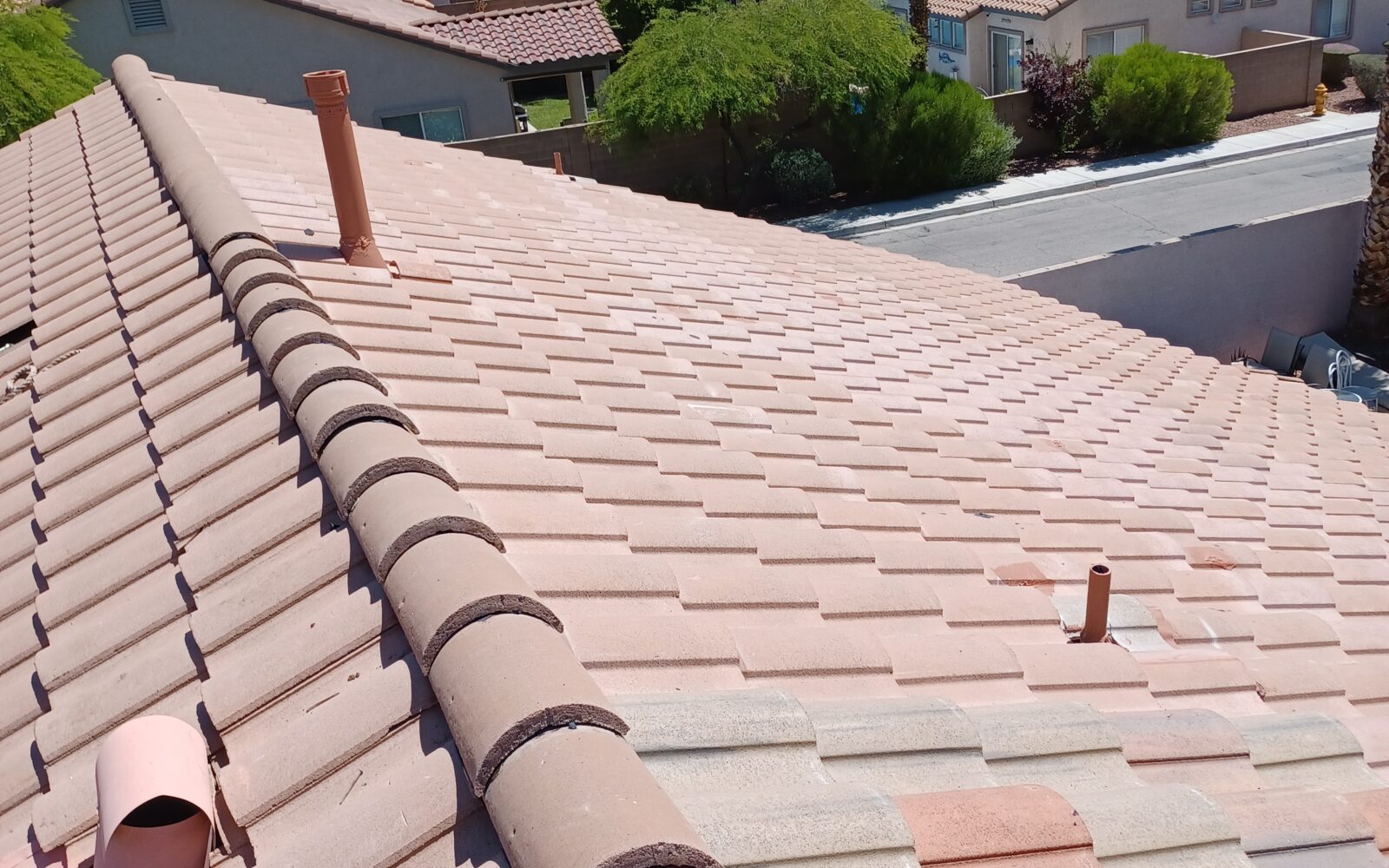
Tile roof repair in the Las Vegas valley is usually underlayment work with tile handling attached. The tile sheds the water and protects what sits beneath it; the underlayment beneath carries whatever gets past and is the layer that actually keeps the building dry. Decades of heat and ultraviolet exposure make that layer brittle long before the tile shows anything at all, which is why a tile roof here leaks with every tile apparently in place.
That changes what a repair looks like. The work is not replacing tiles. It is lifting them, finding where the layer underneath has split, cutting back to sound material, rebuilding the flashing at the detail that failed, and putting the same tile back.
Where valley tile roofs actually leak
- Valleys, where volume concentrates and the underlayment takes the most water
- Headwalls and parapet terminations, where tile meets a vertical surface
- Pipe and vent penetrations, where an original collar has gone hard and split
- The junction with low slope membrane, over walkways, additions and mechanical areas
- Under equipment and anywhere people walk, where tiles are cracked and nobody reported it
- At fixings, where the underlayment was punctured and the lap no longer protects it
Repair, relay or replace
| Local repair | Lift and relay | New tile roof | |
|---|---|---|---|
| What it addresses | One detail or area | Underlayment across an elevation or the whole roof | Everything, including the tile |
| Existing tile | Stays | Removed, stacked and reset | Replaced |
| When it fits | Underlayment sound elsewhere | Underlayment brittle, tile still serviceable | Tile broken or failing in quantity |
| Disruption | A day or two | A planned project in sections | A full reroof |
| What it buys | Stops this leak | Resets the layer that fails | A new roof assembly |
Most buildings move through that table in order over a long ownership, and the decision point is what the sample lifts show. If the underlayment is brittle everywhere a tile comes up, further individual repairs are money spent on a layer that is going to need replacing anyway.
Why the heat is the whole story
A dark tile roof in the valley reaches surface temperatures far above air temperature through the summer, and the assembly below swings through a wide range every single day. Organic underlayment hardens, loses flexibility and splits at the points where it is already stressed: laps, fixings, valleys and the upstand at any vertical surface. Nothing above it changes, which is why a roof can present as unchanged for years while the layer doing the work reaches the end of its life. What the desert heat does to a roof covers the mechanism across systems.
Dust matters too, in a smaller way. Grit washes into valleys and around penetrations, holds moisture against the underlayment after a storm, and blocks the outlets that are supposed to clear the water away. A repair that does not clear that is half a repair.
Working around a building and a season
Tile work on an occupied building is quieter and less disruptive than membrane work, and it still needs planning. Tiles come off and get stacked, which means a safe route and somewhere to put them. Summer work starts early and follows the shade. Associations and design review bodies often have a view on substitute tile, and that is settled before the work rather than after.
Where the building has both tile and low slope areas, we look at both on the same visit, because the transition between them is where a large share of leaks starts. Commercial roof repair in Las Vegas covers the membrane side, and roof leak repair covers tracing an entry point when the source is not obvious.
What to do next
Tell us where the water appears and in what weather, and send a photograph if the leak is active. We get on the roof, lift tiles at the leak and at sample points elsewhere, and come back with the finding before the price, because whether you have one failed detail or an underlayment at the end of its life is the thing worth knowing first.
Common questions
Why does a tile roof leak when no tiles are missing?
Because the tile is not the waterproofing layer. Tile sheds most of the water and protects what is underneath, and the underlayment beneath it is what actually keeps the building dry. When that layer goes brittle and splits, the roof leaks with every tile still in place.
- Tile is a weather shield, not a membrane
- Underlayment carries the water that gets past the tile
- Decades of heat make older underlayment brittle
- Splits open at laps, fixings and valleys first
- Nothing about this is visible from the ground
That is why a tile roof here is usually reported as sound right up to the point it is not. The tile outlives the layer beneath it by a wide margin in this climate, so a roof can look exactly as it did twenty years ago while the underlayment reaches the end of its service life. The only way to know which you have is to lift tiles and look, at the leak and at a sample of other locations, and that sample is the difference between a repair and a surprise.
Can broken tiles be replaced if the original profile is no longer made?
Usually yes, by one of three routes: salvaged tile from a less visible elevation of your own roof, reclaimed tile from a yard that handles the profile, or a compatible substitute placed where the difference does not show. All three are normal practice on older buildings.
- Salvage from a hidden elevation keeps the visible roof uniform
- Reclaim yards carry many discontinued profiles
- A substitute profile works where sightlines allow it
- Color differs between batches even within one profile
- Ask which route was used and where
Keep a stock of spares if the building is yours for the long term. A pallet of matching tile bought during a larger job costs very little, takes up a corner of a store room and removes this problem entirely for the next repair. Where an association or a design review controls appearance, settle the substitution question with them before the work rather than after, since a visible mismatch is harder to argue about once the tiles are fixed down.
Can people walk on a tile roof without breaking more tiles?
Yes, with technique and care, though some breakage on an older roof is realistic rather than avoidable. Weight goes on the lower third of each tile where it is supported by the one below, or on the battens, and routes across the roof are planned rather than improvised.
- Step low on the tile, where it is supported
- Walk the battens where the roof allows it
- Plan a route and reuse it rather than roaming
- Older concrete and clay tile is more brittle
- Expect and budget for some replacement
This is also an argument for keeping traffic off the roof between visits. Every trip up for an aerial, a solar panel, a satellite dish or an evaporative cooler costs a few tiles and sometimes a flashing, and the damage is rarely reported by whoever caused it. Where rooftop equipment has to be reached regularly, the right answer is a defined walkway rather than a standing instruction to be careful.
Does the underlayment have to be replaced before the tile wears out?
On a valley roof, almost always. Concrete and clay tile commonly outlast the layer beneath them by a wide margin in this heat, so a tile roof typically needs its underlayment renewed at least once while the original tile stays in service.
- Tile and underlayment have very different service lives
- Heat and ultraviolet exposure drive the underlayment failure
- The work is a lift and relay, not a full reroof
- Existing tile is reused where it survives handling
- Breakage during handling sets the replacement tile cost
A lift and relay is the job this leads to: tiles removed and stacked, old underlayment stripped, new underlayment and flashings installed, then the same tile reset. It is a larger project than a repair and considerably less than a new tile roof, and it resets the clock on the layer that actually fails. When repairs at separate locations start finding brittle underlayment each time, that is the signal to price it.
Is it worth repairing tile sections on a roof that also has flat areas?
Yes, and the transition between the two is the first place to look. Most valley buildings with tile also have low slope membrane over walkways, additions or mechanical areas, and the junction between tile and membrane is where a disproportionate share of leaks begins.
- Tile to membrane transitions move differently and open up
- Water from the tile discharges onto the flat area
- A blocked drain floods the junction from below
- Both systems age at different rates on one building
- One visit should cover both rather than one at a time
Price the roof as one thing even when it is built from two systems. A repair on the tile that ignores the membrane it drains onto leaves half the path untouched, and a membrane repair under a tile elevation that is shedding grit and water onto it will be back. Our [commercial roof repair](/services/commercial-roof-repair/) page covers the low slope side, and both get looked at on the same visit.