Las Vegas the city is not Las Vegas the valley. Inside the city limits sits the widest mix of commercial property in Southern Nevada, and almost none of it went up at the same time. Buildings from several decades stand within a block of each other, which means the roofs we are asked to look at here have less in common than they do anywhere else we work.
Downtown, the medical district and everything between
Downtown carries the oldest commercial roofs in our work. Small parapeted roofs over masonry buildings, built up systems patched by a succession of owners, and later additions that were roofed after the original and drain into it. A short distance away the stock changes completely: purpose built medical offices and clinics with screened equipment decks, then office buildings, then single story retail, then the small industrial units behind them where the roof is most of the building.
That mix decides what we prepare for before we arrive. A tenant improvement above a shopfront and a clinic with an imaging suite under the roof are not the same job, and neither is the trade unit behind them.
Layer on layer, and what that hides
On the older stock the first question is how many roofs are up there. A building recovered twice has a thick assembly with moisture somewhere inside it, and the leak that shows indoors is rarely above the fault. A test opening is quicker than guessing, and on a layered roof it is the only way to know what the deck is made of before anyone prices a replacement.
The second question is the parapet. These roofs drain to internal outlets or through scuppers in a wall that moves independently of the deck, so counterflashing creeps, coping joints open, and water gets behind the membrane rather than on top of it. That is why the stain turns up at the top of an interior wall rather than on the ceiling.
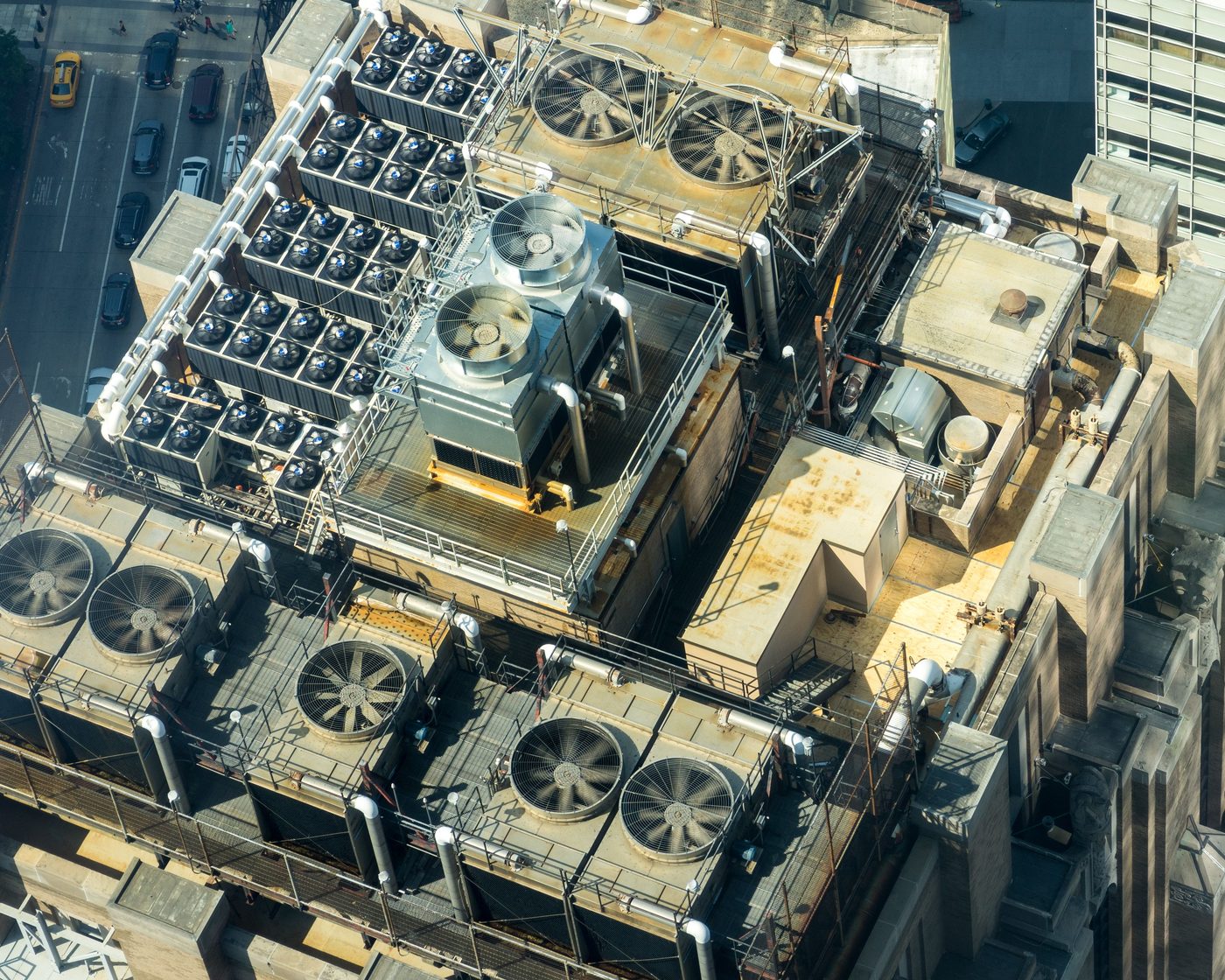
On the medical district roofs the emphasis moves. Those roofs are dense with equipment and the spaces below tolerate no water at all, so we look at curb flashings, condensate discharge and the route technicians take from the hatch before we look at the field.
Loading, hours and which building department
Access downtown is the constraint, not the roof. Many of the older buildings have no yard, no loading area and a frontage that has to stay usable, so materials go up from the street in an agreed window and waste comes down the same way. That window usually decides the start date, so it is the first thing booked.
On the office and medical buildings the constraint is hours and odor. Work above occupied consulting rooms is planned around clinic sessions, and any product that smells is planned around the fresh air intakes rather than the other way round.
Then the permit office, which is the part people get wrong. A Las Vegas mailing address does not settle it, because a great deal of the valley is unincorporated county. We confirm the jurisdiction from the parcel before an application rather than after, and it is worth you knowing the answer as well, since it decides who you call about an inspection and where the final sign off comes from.
Common questions
How do I tell whether a Las Vegas address is inside the city limits?
Look it up on the parcel rather than on the envelope. A building can carry a Las Vegas mailing address while sitting in unincorporated Clark County.
- The assessor's parcel record and the city address lookup both answer it
- It is a matter of record rather than judgment
- The application goes to a different counter
- Inspections are booked with a different office and a different set of inspectors
- Submission requirements are not identical, so one package is not both
The cost of getting it wrong is time: a permit applied for at the wrong office is restarted, and on a leaking roof that delay lands badly. We confirm jurisdiction from the parcel before anything is submitted. Keep the permit and the signed inspection record with your roof documents.
Our downtown building has been recovered before. Does the old roof have to come off?
Sometimes, and the survey decides it rather than preference. A recover is faster, quieter and produces far less waste, which matters downtown, but it is only available on a roof whose existing layers are dry and sound.
- Water in the assembly rules it out, since a recover seals it under a new roof
- The deck then corrodes unseen and the eventual tear off is larger and dearer
- Code limits how many systems may be stacked, and older stock may be at the limit
- Weight matters too, because every layer adds load to a structure designed for less
- Where there is doubt, the structural question gets asked before the roofing one
So the order is: survey for moisture, establish how many layers are there, confirm what the deck is, then decide. A quote offering a recover without any of that has skipped the part that decides whether it works.
Why do older Las Vegas roofs fail at the parapet first?
Because the parapet joins two structures that move differently, using a detail that has to stay watertight. The deck moves with temperature, the wall heats on its outer face and moves on its own schedule, and the flashing absorbs the difference daily.
- Counterflashing creeps out of its joint, usually at a corner
- Water then runs behind the base flashing rather than over it
- Coping joints open, letting water travel inside the masonry
- Base flashing goes brittle at the bend, the point that flexed most
- A parapet leak shows high on a wall, often far from the fault
That is why diagnosis matters here. Owners patch the field and the stain keeps growing, because water moves along the top of the wall before it comes down. On an older downtown roof we walk the perimeter and the coping first, and we read the inside walls before we read the ceiling.
Where do materials and waste go on a downtown Las Vegas job?
Up and down the outside, in a window agreed in advance. Many older downtown buildings have no yard, no dock and nowhere to stage anything.
- The roof is loaded by crane or hoist from the street
- Tear off comes down the same way into a container the permit limits
- The lifting window decides the start date
- Container size decides how much roof can be stripped in a day
- Whatever is opened is closed and watertight before the street is handed back
Sidewalk protection, pedestrian routing and a plan for weather stopping work all belong in the same package, and on an occupied building we agree which entrances stay in use. Tell us at the site visit what access the building actually has, including anything a neighboring property must agree to, because that conversation is slower than the roofing.