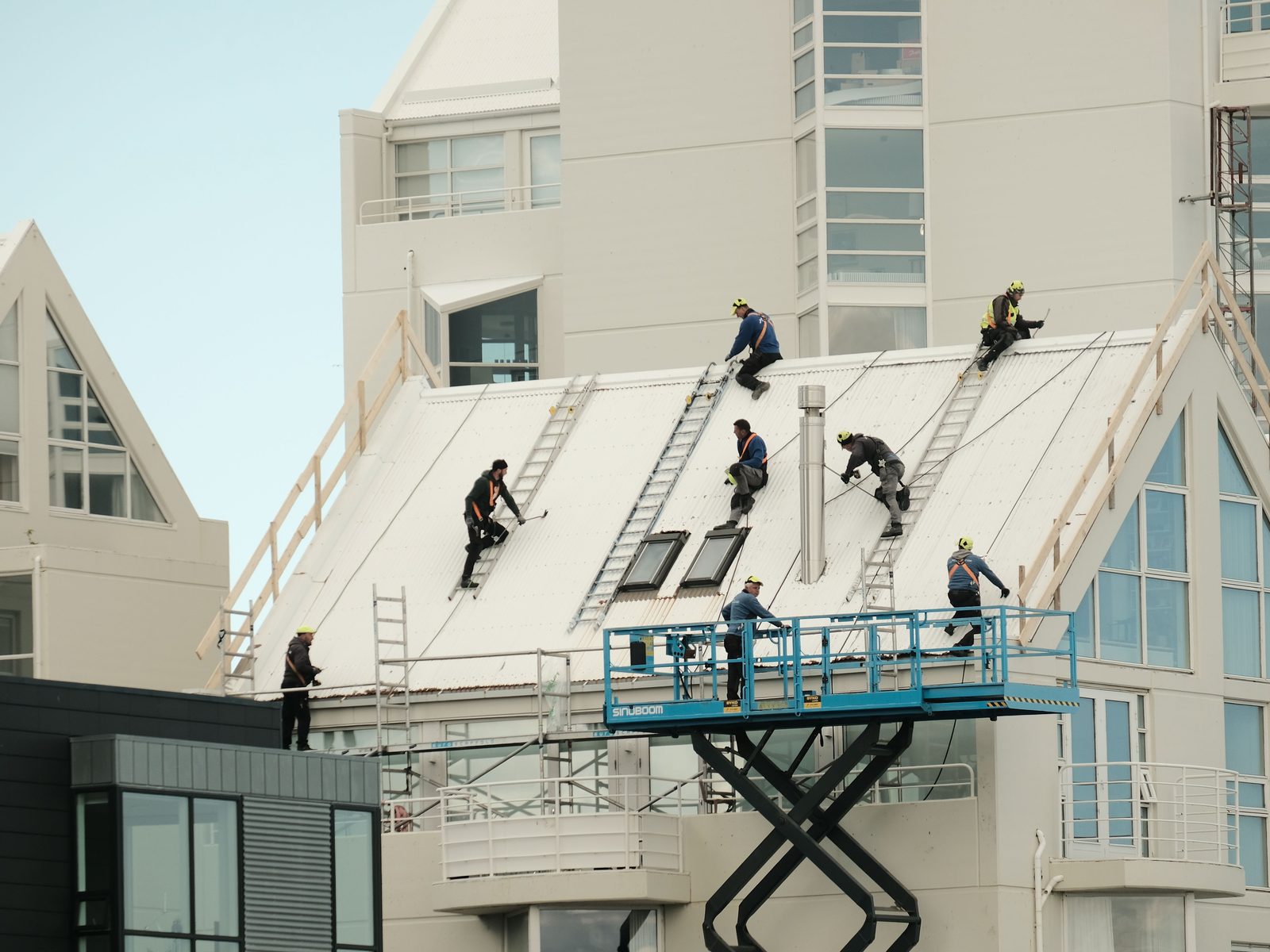
Laughlin sits on the Colorado River at the southern tip of the state, far lower than the Las Vegas valley and reliably the hottest place we work. The valley is hot. This is hotter, and every recommendation on a roof here starts from that.
Riverfront resorts and the town behind them
The casino and hotel property along the river carries the largest roofs in town. Tower roofs crowded with cooling equipment and antennas, podium roofs over gaming floors and event space, kitchen exhaust running all day, and curbs by the dozen above rooms that are occupied.
Behind them sits the commercial property that keeps a resort town running: retail, offices, medical and service buildings, lodging, storage and small industrial units. Most of that is low slope membrane over a modest footprint, and a good deal of it has been repaired over the years by whoever was available, which shows up as patches in materials that do not match what is underneath.
Different buildings, one shared condition. Whatever is on the roof, the surface under it is holding a temperature higher than anything the same roof would see further north.
What the heat decides
Air temperature is not the figure that matters. The surface of a low slope roof in full sun runs well above it, higher on a dark surface, higher again where a previous repair left a darker patch in a reflective field.
That surface temperature governs the specification. Asphalt based surfaces soften. Some membranes stay flexible across a wide range and others stiffen over years of it. Adhesives and sealants have a working window that the middle of the day closes. Every lap, curb and hand formed detail absorbs a daily movement that is wider here than in the valley, so the details are where a roof in Laughlin gives way first and where the extra care belongs.
Reflectivity is the other half of it. A surface that returns sunlight runs cooler, and everything under it ages more slowly, which makes a reflective finish worth more here than anywhere else we work. It also has to be kept clean to do anything at all, so cleaning belongs in the maintenance scope rather than in a list of optional extras.
Rooftop equipment feeds back into this. Cooling plant runs longer through the season, so more condensate lands on the membrane and more service traffic crosses it. We look at seams, laps, sealant, surface condition, walkway routes and condensate discharge before we look at anything else.
The working day, and a county permit
Heat sets the schedule as firmly as weather sets it elsewhere. Work that depends on a controlled temperature is done early, the afternoon takes strip out, preparation, fastening and loading, and materials stay shaded until they are needed rather than cooking on the deck. Survey visits are morning visits, because a roof too hot to kneel on gets inspected from standing height, and the faults that matter here are small.
Access is straightforward on the town commercial and negotiated on the resort property, where routes, hours and contractor procedures belong to the property rather than to us.
Permits and inspections go through Clark County, because Laughlin is an unincorporated town rather than a city. The office is familiar and the distance is not, so inspections are booked into the program at the start rather than called for when the roof is ready. Tell us about every building you have down here at the same time, and the trip gets planned around all of them.
Common questions
Is a roof in Laughlin hotter than the same roof in Las Vegas?
Yes. Laughlin sits down on the Colorado River at the southern tip of the state, far lower than the valley, and low elevation here means higher summer air temperatures. It is the hottest place we work.
- What matters to a roof is surface temperature, not air temperature
- In full sun it runs well above the air, higher again on a dark surface
- Higher still on anything patched with a material darker than the field
- It ages the membrane and drives the daily movement the seams absorb
- It also decides whether an adhesive behaves as the data sheet says
A valley specification is not automatically wrong here, but it is being asked for more, so the margin has to come from reflectivity, the material and the way details are built. The inspection emphasis shifts too: seams, laps, sealant and anything that has softened, shrunk or pulled.
Do you work through the afternoon in Laughlin in summer?
Not by default, and not because it is uncomfortable. Some operations genuinely do not work on a surface that hot.
- Adhesives and coatings have a range on the container, and outside it the result fails
- Membrane handled hot moves as it cools and ends up under tension
- Sealant on a surface too hot to touch skins before it wets the substrate
- Early hours take the temperature sensitive work
- Afternoons take strip out, preparation, fastening, clearing and loading out
Materials are stored shaded and brought up as needed, because a roll left in the sun for hours is no longer the product specified. Survey visits are morning visits for the same reason: a roof too hot to kneel on gets looked at from standing height, and the faults here are small ones.
Which roof systems hold up in this kind of heat?
The honest answer is that the system matters less than three things: reflectivity, how the material behaves at high surface temperature, and how well the details are built.
- A surface that sends sunlight back runs cooler, so everything ages slower
- It performs on its condition, so one dulled by grit is not doing the job
- Asphalt based surfaces soften as they get hotter
- Some membranes stay flexible across a wide range, others stiffen and shrink
- Fastening has to cope with deck and covering moving at different rates
The details come third and fail first. Laps, curbs, terminations and anything formed by hand absorb the daily movement, so here they earn wider laps, better terminations and walkway pads on the routes that get used. Tell us what the building does and what sits above and below the roof.
Laughlin is in Clark County. Does that make permitting the same as in the valley?
The office is the same and the geography is not. Laughlin is an unincorporated town, so permits and inspections go through Clark County, as they do for the unincorporated parts of the valley.
- What differs is the distance, which changes programming rather than approval
- Inspections go into the schedule at the start, not when the roof is ready
- A replacement cannot open more roof in a day than it can close
- The inspection that must see the deck sets that limit
- A valley contractor may not have submitted down here before
Ask about that at quote stage, along with who files the application and whether the cost sits in the price. Distance is also the reason to plan rather than react: if you have more than one building here, or work you were putting off, say so at the start so it happens on one visit.