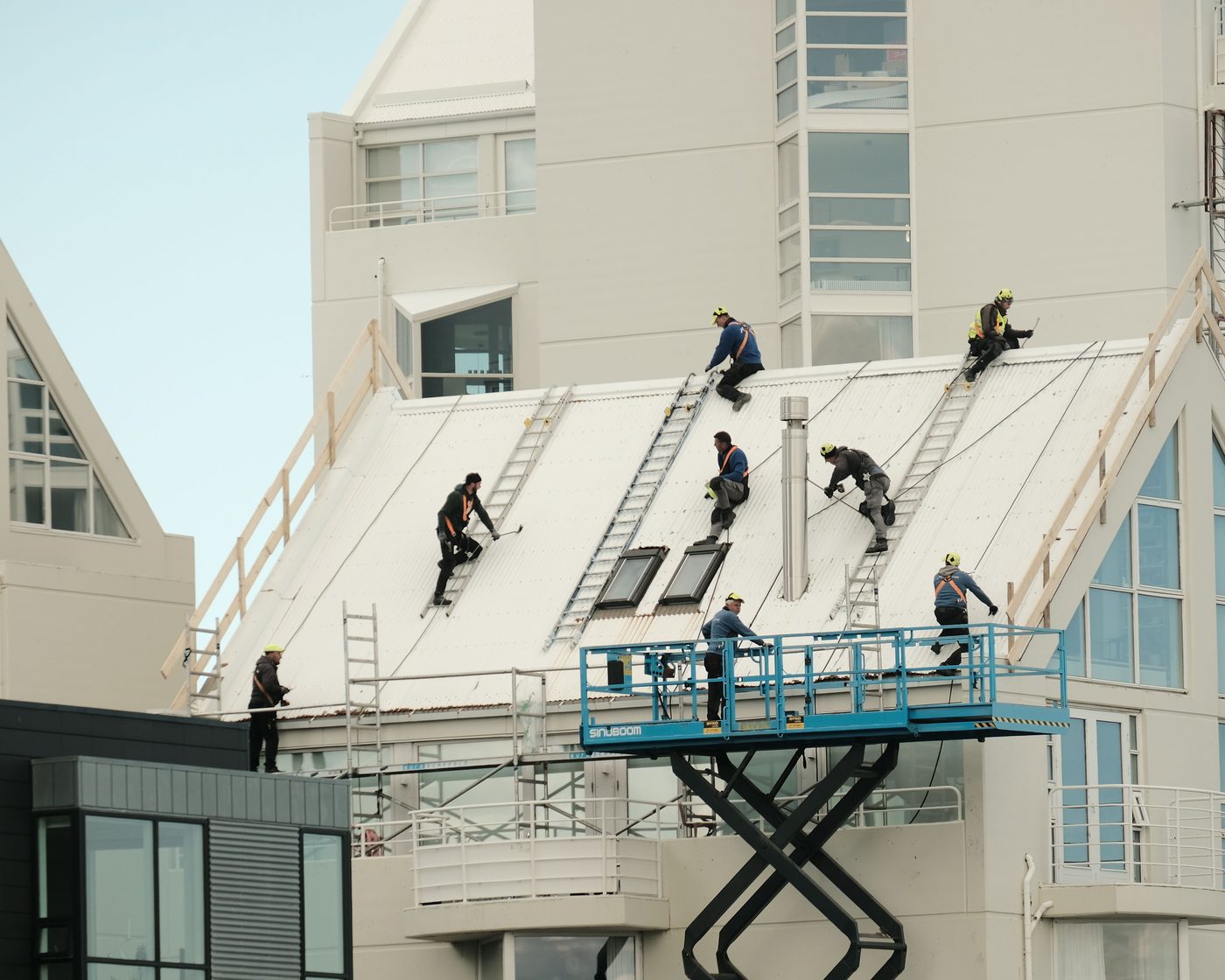
Henderson is a city in its own right, not a district of Las Vegas, and its commercial property is mostly newer than the valley’s older core. Light industrial and distribution sit along the freight routes, healthcare and professional offices cluster near them, and between the two there is a great deal of retail and association owned property.
Distribution units next to medical suites
The unusual thing about Henderson is how close the extremes sit. One business park can hold a distribution unit with a wide low slope roof and almost nothing on it, and two units along, a medical or office suite whose roof carries more equipment than it has open field.
The rest is retail, from single pad buildings to centers with a dozen tenancies, and association property: condominium and apartment buildings where pitched coverings meet small flat sections over corridors, entries and stair cores, plus clubhouses and amenity buildings. Those flat sections are commercial work even where the building is residential, because the association owns them, funds them from reserves and has to make one decision across several buildings at once.
So there is no single Henderson roof. There is a roof per building type, and the first useful question is which of the three we are being asked to look at.
Two failure patterns on the same street
On the industrial units the field is the asset and the perimeter is the risk. Few penetrations, long runs to the outlets, and most of what goes wrong happening at edges, at dock canopies where vehicles and equipment do physical damage, and wherever a later tenant cut in an exhaust fan or a condenser and made the roof good badly.
On the office, medical and retail roofs the opposite holds. The field is rarely the problem. The problem is that the roof is a service platform, walked constantly by people maintaining equipment that has nothing to do with roofing.
Because so much of this stock is newer, owners assume there is nothing to find. Newer roofs do not fail in the field. They fail at details, and details age on their own schedule regardless of the year on the certificate. So on a Henderson roof we inspect details first: curbs, boots, condensate lines, edge metal, and anything added after the roof was signed off.
Booking around tenants, and a city of its own
Most commercial property here is tenanted, and that governs the schedule more than the work does. Notice has to reach occupiers, roof access has to be arranged with whoever holds the keys, and above a medical or office suite the permitted hours are set by what happens below. Where the lease lets tenants send their own contractors up, agree in writing who may go on the roof and who reports what they touched, because that is the source of a large share of the damage we find.
Then the permit. Henderson runs its own building department, so an address inside the city is handled there rather than by the county. The boundary is not obvious on the ground, and the city meets unincorporated county in several places, so we confirm it from the parcel address before an application. Getting that right is a lookup. Getting it wrong is a restart, and on a roof waiting for the monsoon window a restart is expensive.
Common questions
What does it change that Henderson runs its own building department?
It changes where the application goes, who inspects the work and which submission requirements apply. Nothing about the roofing itself changes. The administration around it does.
- Henderson is an incorporated city, so an address inside it is not a county job
- A package prepared for the county is not automatically the right package
- Inspections are booked with the city and carried out by its inspectors
- On a replacement the deck has to be seen before the new system covers it
- The record you finish with is a Henderson record
The mistake we see is assuming the jurisdiction from the neighborhood. Henderson meets unincorporated county in several places, and a building that feels like it is in Henderson may sit outside the limits. Settle it from the parcel address, ask who applies for the permit, and keep the sign off with the roof file.
We have a warehouse and an office suite in the same Henderson park. Can one plan cover both?
Yes, and it usually should, but the plan has to treat them as two different roofs. One visit, one report and one schedule save money and give you a single record.
- On the distribution unit the priorities are drainage and the perimeter
- The outlets, any area still holding water a day after a storm, the edge metal
- Dock canopy details, where vehicles and equipment do physical damage
- On the office suite the priorities are penetrations and traffic
- Curb flashings, condensate discharge, walkway routes and conduit added later
What the plan must not do is apply the same inspection to both, because the two buildings fail in different places. The report should reflect that split: two condition sections, two sets of recommendations, and one ranked list across both. If you have more buildings in the park, say so at the start.
The flat sections over our Henderson condominium walkways keep staining inside. Why those?
Because those sections are the hardest part of the roof and the least looked at. The pitched areas get the attention while the small flat roofs hold the transitions, the crickets and the penetrations.
- They are often too small to walk comfortably, so they are inspected from a distance
- Water arrives from the pitched roofs above, so they carry far more flow
- Anything partly blocked backs up at once
- The transition where pitched covering meets flat membrane is formed by hand and fatigues
- One outlet or a short scupper means a blockage is a full stop
Clear those sections before the monsoon window, treat each transition as a detail to be inspected rather than a joint to be assumed, and photograph them yearly so the board can see whether they are moving. Where one has failed, the fix is a rebuilt transition and a proper outlet.
Are newer Henderson buildings less likely to need roof work?
Less likely to need replacing, yes. Just as likely to need attention. Age tells you how close a roof is to the end of its life and very little about whether it is leaking.
- A newer roof fails at its details long before the field wears out
- Sealant at penetrations hardens on the same schedule whatever year it went on
- Curb flashings fatigue because units vibrate and metal moves with temperature
- Equipment added after handover puts new penetrations through a finished roof
- In a business park that happens every time a tenancy changes
There is a second reason not to relax. A newer roof is often still inside a manufacturer warranty, and most of those require documented maintenance for the cover to stand. What changes with age is not the routine but what the inspection expects to find, and on newer stock that is almost always a detail.