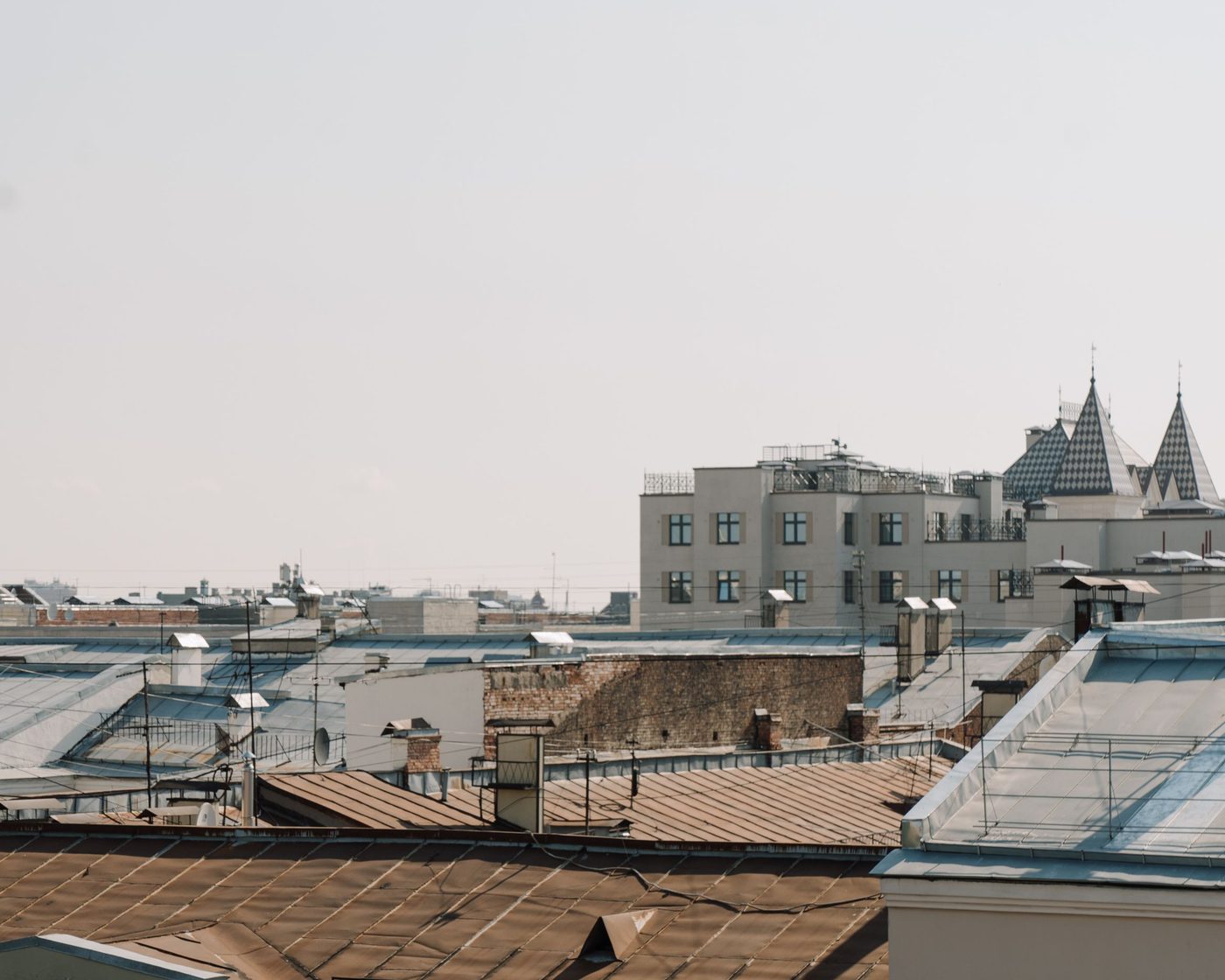
This is a roof checklist for a restaurant, a commercial kitchen, or any tenancy with grease laden extract. The roof above a kitchen fails differently from the roof above the dining room, and most of this checklist concerns the difference.
Run it quarterly where there is a grease hood, and tie it to the extract cleaning visit.
Before you go up
Agree access with the kitchen. Hot extract, live gas and running refrigeration are all on this roof, and the safe time to walk it is rarely the middle of service.
Take a roof plan with the hoods, the units and the drains marked.
Around the extract
| Look at | What a problem looks like |
|---|---|
| Membrane downwind of a hood | Dark staining fanning out, softened or sticky surface |
| Grease containment | No filter box, a full pad, a box overflowing onto the roof |
| The hood curb | Mastic at the corners, flashing slipped, fixings through the membrane |
| Ductwork | Loose sections, open joints, grease at a seam |
| Fan housings | Vibration marks, loose fixings, sealant failed at the base |
| Drains downwind | Grease in the sump, a film on the strainer |
The refrigeration and equipment
| Look at | What a problem looks like |
|---|---|
| Condensate discharge | A permanently damp patch, organic growth, staining |
| Condensate pipework | Disconnected, broken, discharging short of the drain |
| Unit bases and stands | Feet bearing directly on the membrane, pads crushed or moved |
| Vibration damage | Fixings worked loose, sealant cracked at the base |
| Gas and electrical runs | Resting on the membrane, fixings driven through the roof |
| Panels and covers | Left open or propped after a service visit |
The traffic
| Look at | What a problem looks like |
|---|---|
| Walkway pads | Missing, or ending short of the equipment people service |
| The actual route | Wear where the shortcut is, not where the pads are |
| Impressions and punctures | Footprints, ladder feet, dropped tools, dragged equipment |
| Near hatches and ladders | The busiest few square feet on the roof |
| Evidence of recent work | New fixings, offcuts, sealant, scuffs nobody logged |
The drainage
| Look at | What a problem looks like |
|---|---|
| Outlets and strainers | Grease film, debris, dust and grit packed into the sump |
| Standing water | Water held after dry days, often near a condensate discharge |
| Scuppers and overflows | Blocked, missing, or staining the wall below |
| Gutters | Grease deposits, debris, sagging, open joints |
| Grease at ground level | Staining below a scupper or downpipe, which is a separate problem |
Inside the building
| Look at | What a problem looks like |
|---|---|
| Kitchen ceiling | Stains, sagging tiles, damp around a hood penetration |
| Dining area ceiling | New staining, which is a commercial problem as well as a roof one |
| Store rooms and cellars | Damp, staining, stock damage nobody has reported |
| Plant and service voids | Trays, buckets or diverters somebody has accepted |
| What the kitchen staff say | Where it drips, and in which weather |
What to do with it
- Fix grease at the hood, not on the roof. Containment ends it; cleaning only delays it.
- Pipe every condensate discharge to a drain. This is a cheap permanent fix for a repeating repair.
- Keep an access log. Most damage on this building type comes from a trade that is not roofing.
- Put pads where people actually walk. Usually between the hatch and the units.
- Tie the roof check to the extract clean. One visit, two jobs, at the right frequency.
Want the reasoning behind these checks? Read how building type changes the roof and what a maintenance program covers.
Walked by Date Roof
Common questions
Why do restaurant roofs fail faster?
Because of what goes through them and what sits on them. A kitchen roof carries grease laden extract, heavy refrigeration, constant condensate and far more foot traffic than an ordinary commercial roof, and every one of those shortens the life of the membrane underneath.
- Grease degrades most single ply membranes over time
- Refrigeration and extract units bring weight, vibration and service traffic
- Condensate discharge keeps areas permanently damp
- Service visits are frequent and rarely logged
- Deliveries and waste handling bring traffic to areas never designed for it
The roof above a kitchen does more work than any other part of the building envelope, and it is usually specified as though it were an ordinary roof. That mismatch is why the area around a hood can be at the end of its life while the rest of the same roof has years left in it. Treat the area around the kitchen as its own zone with its own inspection frequency. Averaging it in with the rest of the roof hides a problem that is concentrated rather than general.
What does grease damage look like?
A dark, stained area spreading downwind of an extract hood, often with a softened or discolored membrane beneath it and a slick film on the surface. It is also a slip hazard and, where it reaches a drain, a drainage problem.
- Staining that fans out from the hood in the prevailing wind direction
- Membrane softened, discolored or sticky to the touch
- A film on the surface that does not wash off
- Grease reaching outlets, gutters and the ground below
- Organic growth thriving in the greasy film, particularly in shaded areas
Grease containment at the hood is the fix, not cleaning the roof repeatedly. Filters, grease boxes and absorbent pads all exist for exactly this reason, and keeping them serviced is a kitchen task rather than a roofing one. The roofing cost arrives later, as a replacement of the area the grease has reached. Photograph the stained area and its outline on every visit. A spreading edge means the containment is failing now; a stable one means you are looking at historic damage that has already stopped.
Who should be allowed on the roof?
Named trades, by arrangement, with a route and a log. A restaurant roof typically sees extract cleaners, refrigeration engineers, gas engineers and delivery contractors, and most roof damage on this building type is caused by somebody who was not a roofer.
- Keep an access log with date, trade and reason
- Agree a walking route and mark it with pads
- Require that panels and hatches are refastened, not propped
- Inspect after any significant service visit
- Require tools and materials to be carried, not dragged across the membrane
The log costs nothing and settles the question that always arises after a leak, which is when the damage happened and who was up there. It also changes behavior, because a contractor who signs in behaves differently from one who does not know anybody is paying attention. Keep the log by the roof hatch rather than in an office, because a log somebody has to go and find is a log nobody fills in. One sheet on a clipboard is enough to change the habit.
What about condensate from refrigeration?
It needs piping to a drain, not discharging onto the roof. A continuous trickle onto a membrane keeps an area permanently wet, grows organic matter, and ages the material far faster than anything the weather does here. It is also one of the few roof problems that gets worse in the weeks with no weather at all.
- A permanently damp patch is the giveaway, even in dry weather
- Organic growth and staining follow within a season
- The membrane below softens and ages early
- Condensate running to a low spot creates standing water
- A pump that has failed, leaving the discharge running at the unit itself
This is one of the cheapest problems on the list to solve and one of the most commonly left alone. A short run of pipe to the nearest outlet ends it permanently, and the alternative is a repeating repair in the same spot every few years while the cause continues discharging onto it. Check it in dry weather, which is when it is unmistakable. A damp patch on a roof that has not seen rain for weeks has only one explanation and it is standing a few feet away.
How often should a kitchen roof be inspected?
Quarterly is reasonable where there is grease laden extract, and twice a year at minimum. This is more often than most commercial roofs need, and the reason is the rate at which the area around the hood changes rather than the roof as a whole.
- Quarterly where grease extract discharges onto the roof
- After every extract cleaning visit, which is also an access event
- Before the monsoon season, like any roof in this valley
- After any refrigeration or gas work on the roof
- After any roof work by a trade other than a roofer, whatever the schedule says
Tie the roof inspection to the extract cleaning schedule, which is already a legal and insurance requirement in most kitchens and already happens on a set frequency. One trip, two jobs, and the roof gets looked at by somebody at exactly the moment the most likely source of damage is being worked on. Keep the two reports together in one file. A pattern that links roof damage to particular service visits is obvious when the records sit side by side and invisible when they do not.