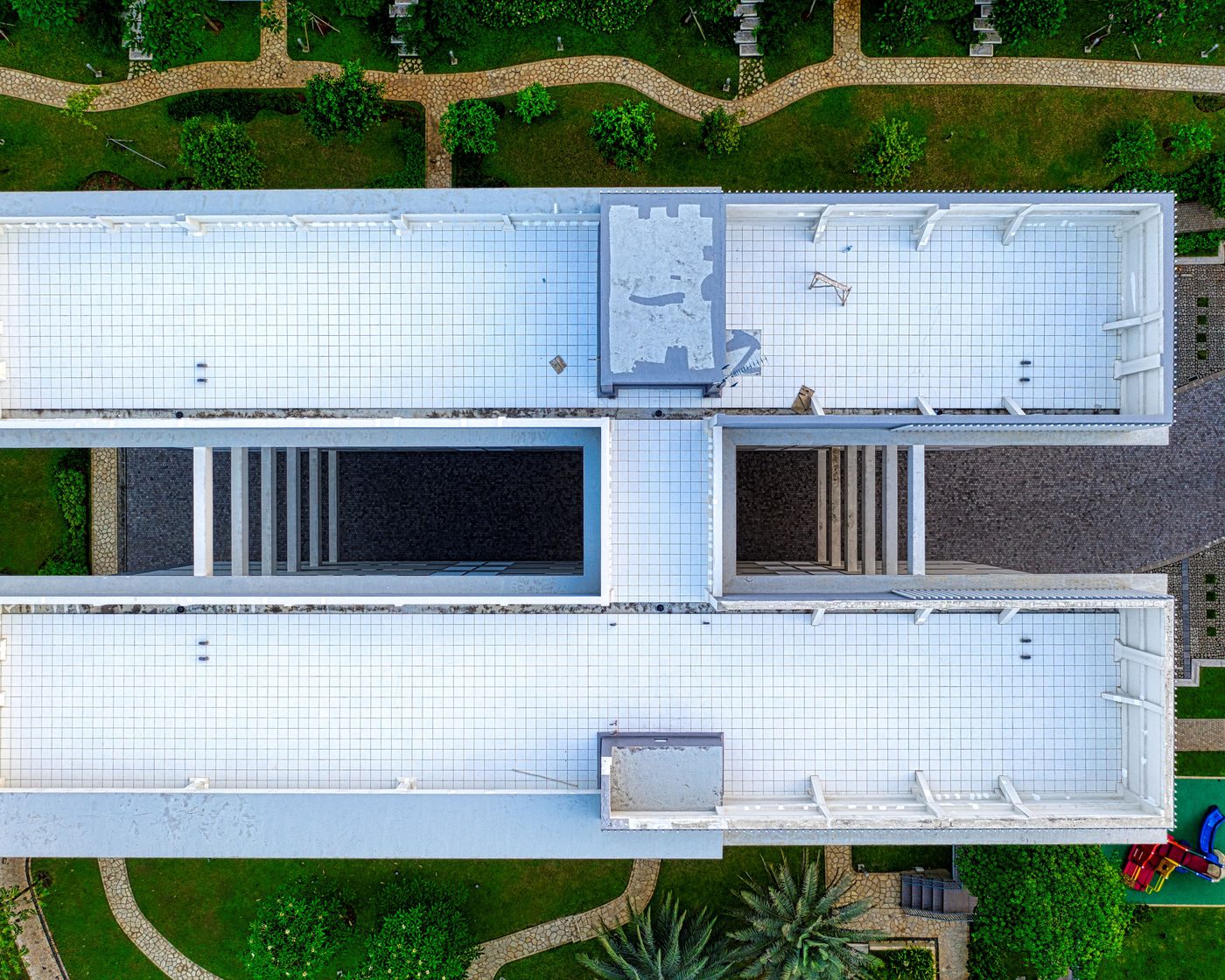
This is a roof checklist for a warehouse or distribution building. It covers the roof, the equipment on it, and the inside of the building, which on this type of property tells you more than the roof often does.
Run it twice a year, and before the monsoon season in particular.
Before you go up
Agree the route with the site. Warehouse roofs have fragile areas, rooflights and service runs, and a roof plan marked with those is worth more than any amount of care once you are up there.
Never step on or near a rooflight. Treat every one as fragile unless somebody can prove otherwise in writing.
The field and the laps
| Look at | What a problem looks like |
|---|---|
| Side laps and end laps | Edges lifting, a dirt line along the lap, a visible step |
| Fastener lines | Fasteners backing out, dimpling, splits following the line |
| The open field | Splits, punctures, dropped items, scuffs from recent work |
| Deck deflection | Water standing in a line between supports rather than at an outlet |
| Blisters | Raised areas, soft underfoot, growing between visits |
| Surfacing or coating | Bare patches, chalking, wear along the walked routes |
The rooflights
| Look at | What a problem looks like |
|---|---|
| Dome condition | Crazed, cracked, yellowed, or patched with tape |
| Flashings and upstands | Lifted at the corners, sealant cracked or missing |
| Fixings | Loose, missing, or driven through without a washer |
| Fall protection | None fitted, or netting that has aged and sagged |
| From inside | Daylight through a joint, staining on the deck below |
The perimeter and drainage
| Look at | What a problem looks like |
|---|---|
| Gutters, internal and external | Debris, silt, standing water, a joint that has opened |
| Outlets and sumps | Packed with dust and grit, water sitting between rains |
| Overflows | None fitted, or blocked at the opening |
| Edge metal and trim | Loose, lifted, joints open, staining down the wall |
| Parapet upstands | Membrane pulling away, a gap at the top, a slumped corner |
| Downpipes | Blocked, disconnected, discharging against the building |
The equipment and later additions
| Look at | What a problem looks like |
|---|---|
| Extract fans and vents | Curbs sealed with mastic, flashings slipped, fixings through the membrane |
| Later penetrations | Anything added after the roof, detailed by somebody other than a roofer |
| Condensate and discharge | Water onto the membrane, a permanently damp patch |
| Cable trays and conduit | Resting on the membrane rather than on supports |
| Solar arrays | Debris packed at the upwind edge, ballast moved, worn membrane under a foot |
| Loose material | Offcuts, panels, tools, packaging, anything a gust can lift |
Inside the building
| Look at | What a problem looks like |
|---|---|
| The deck, from the floor, lights off | Daylight at a lap, a fastener or a rooflight |
| Deck staining and rust lines | Long term water contact above a surface that still looks sound |
| Steelwork | Rust runs down a beam, water tracking along a purlin |
| Above the racking | Staining nobody can see from the aisle |
| Stock and packaging | Water marks on cartons, damage attributed to handling |
| What the floor staff say | Which bay drips, and in which kind of storm |
What to do with it
- Ask the shift supervisor first. They have been watching the floor for years.
- Walk the aisles with the lights off where it is safe. Daylight finds what a roof walk misses.
- Treat rooflights as a separate program. They age faster than the roof and carry a safety risk.
- Number the bays and tie every finding to one. A large roof without locations produces findings nobody can act on.
- Price the consequence, not just the repair. Stock and downtime are what make the case for a program.
Want the reasoning behind these checks? Read how building type changes the roof and what a maintenance program covers.
Walked by Date Roof
Common questions
What makes a warehouse roof different?
Scale and consequence. The roof is usually the largest single area on the site, it is often the cheapest part of the original build, and what sits underneath it is stock rather than empty space, so a small leak becomes a large claim very quickly.
- A large area means a long perimeter and many outlets to maintain
- Light decks and long spans deflect, which changes where water sits
- Stock below turns a minor leak into an inventory loss
- Racking makes interior inspection harder and slower
- Rooflights, which are common on this building type and age faster than the roof
The economics are different as well. On an office building the roof is a small fraction of the asset; on a distribution building it can be the defining element, and the difference between a maintained roof and a neglected one shows up in the operating cost long before it shows up as a replacement. It is also the building type where nobody goes on the roof between failures, because there is no plant to service and no reason to climb the ladder until something drips.
Where do warehouse roofs usually leak?
At the details rather than in the field, and most often at the laps, the fastener lines, the skylights and the interfaces with rooftop equipment. The open field is large and usually the least eventful part of the roof. The open field is large and usually the least eventful part of the whole roof.
- Laps and side laps, particularly on mechanically fixed systems
- Fastener lines, where movement concentrates
- Skylights and rooflights, which age faster than the roof around them
- Curbs and penetrations added after the original build
- Gutters, particularly internal ones, which are hard to reach and rarely cleared
Anything added after the roof was built deserves particular attention, because it was almost always installed by a trade other than a roofer. Extract fans, cable routes, new services and additional rooflights are where a well built warehouse roof most often starts letting water in, years after the membrane itself was finished. Mark every later addition on the roof plan as you find it. The resulting map is usually a close match for the map of where the building has leaked over the last decade.
How do you inspect the inside of a working warehouse?
From the floor first, looking up, with the lights off where that is possible and safe. Daylight through a roof shows up instantly, and water staining on a deck is visible from below long before anybody finds the entry point above.
- Walk the aisles and look up at the deck, not at the stock
- Lights off makes daylight penetration obvious
- Look along the deck for rust lines and staining
- Ask the floor staff where they have seen drips
- Check above the racking, where staining is invisible from the aisle
The people working under the roof usually know where it leaks, and nobody asks them. A five minute conversation with a shift supervisor is often more productive than an hour on the roof, because they have watched the same patch of floor every day for two years and know exactly which storms produce a puddle. Do the interior walk before the roof walk rather than after it. Knowing which bay drips tells you where to concentrate once you are on the roof, and saves an hour of general looking.
What about skylights and rooflights?
They age faster than the roof, they are a safety risk as well as a water risk, and on an older warehouse they are frequently the single largest source of both. Treat them as a separate item with their own schedule.
- Domes craze, crack and go brittle with age and heat
- Flashings at the corners lift before anything else does
- An aged rooflight will not support the weight of a person
- Replacement is often cheaper than repeated repair
- Older rooflights also yellow, which quietly reduces the daylight they were fitted for
Mark every rooflight on the roof plan and treat the area around each one as a no step zone unless it has been proved otherwise. Falls through aged rooflights are a well known cause of serious injury on exactly this type of building, and the protective measures are inexpensive compared with the consequence. Where a building has many of them, replacing a whole run at once is usually cheaper per unit than replacing them individually as each one fails, and it ends the safety question in one visit.
Is a maintenance program worth it on a large roof?
Usually more so than on a small one, because the cost per square foot of planned maintenance falls with area while the cost of a leak over stock does not. The arithmetic tends to favor a program well before it favors reactive repair.
- Outlet clearing and detail repair scale efficiently across a large roof
- One visit covers a large area, so the cost per square foot is low
- Stock loss and business interruption dwarf the repair cost
- Most warranties require evidence of maintenance anyway
- A program also produces the records a warranty claim will later require
The case is easiest to make with the consequence rather than the roof. A pallet of damaged stock, a half day of disrupted picking and an insurance excess will frequently exceed a year of planned maintenance on the whole building, and that comparison is the one a finance director recognizes immediately. Ask for the program to be priced per visit and per square foot separately. That makes the cost comparable between buildings and makes it obvious which roofs in a portfolio are carrying the others.